turning_on_radio before and after the evaluator fix
pt50 on BEHAVIOR-1K, RTX 5000, 2x action speed. The same instances and seeds run under three evaluators.
What the policy saw at step 0
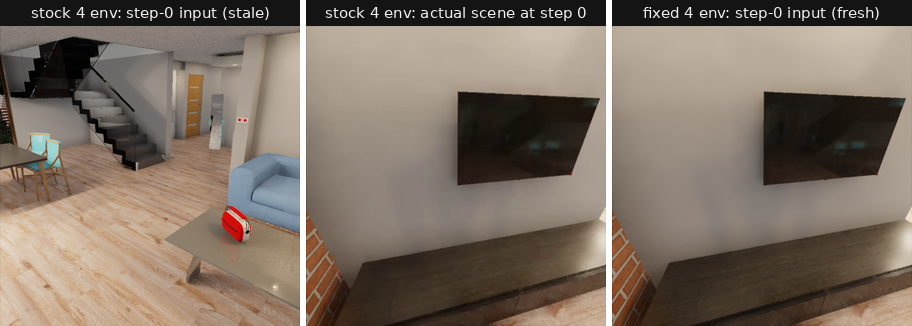
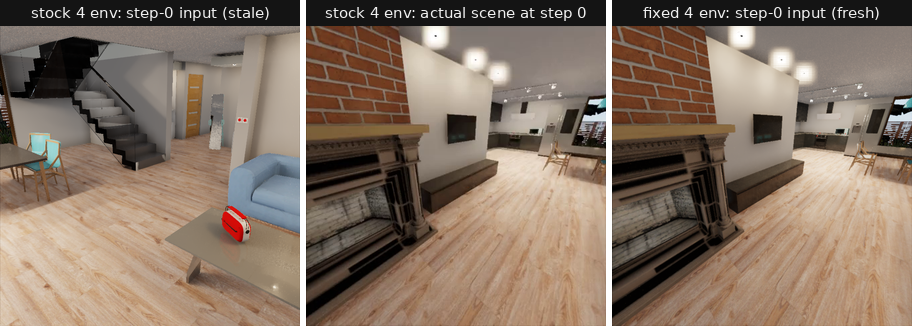
Test instance 5, seed 0. In the stock run the policy received a frame of the living room with the radio on a coffee table right in front of it. The robot was actually facing a TV wall. All 4 envs in that batch got the same stale frame. With the fix, the policy gets the real view.
The first 30 seconds, side by side
Head camera only. The pre-v3.9.3 and fixed runs both drive to the radio and grab it. The stock run plans its first move for the scene it wrongly saw, closes a gripper on nothing, and never moves again.
Every test instance, all five runs
One clip per test instance, each episode sped up about 10x. Top row: before (pre-v3.9.3, 1 env), bug seed 0, bug seed 1. Bottom row: stock 1 env, fixed. Each tile is labelled stale or fresh and success or fail, and finished episodes hold their last frame. The chips under each clip give the same results.
- Before fail
- Bug s0 stale, fail
- Bug s1 success
- 1-env stock success
- Fixed success
- Before fail
- Bug s0 stale, fail
- Bug s1 fail
- 1-env stock fail
- Fixed fail
- Before success
- Bug s0 stale, fail
- Bug s1 fail
- 1-env stock fail
- Fixed fail
- Before fail
- Bug s0 stale, fail
- Bug s1 fail
- 1-env stock fail
- Fixed fail
- Before fail
- Bug s0 stale, fail
- Bug s1 stale, fail
- 1-env stock fail
- Fixed fail
- Before success
- Bug s0 stale, fail
- Bug s1 stale, fail
- 1-env stock success
- Fixed success
- Before fail
- Bug s0 stale, fail
- Bug s1 stale, fail
- 1-env stock success
- Fixed fail
- Before success
- Bug s0 stale, fail
- Bug s1 stale, fail
- 1-env stock success
- Fixed success
- Before success
- Bug s0 fail
- Bug s1 fail
- 1-env stock fail
- Fixed success
- Before success
- Bug s0 success
- Bug s1 success
- 1-env stock fail
- Fixed success
The fix in evaluator.py
After loading a batch, the stock load_batch only re-renders and re-reads observations for tasks that sync lights, and turning_on_radio isn't one of them. The renderer runs a few frames behind, so with several envs the first observation still holds an old frame. The fix does the re-render and re-read for every task.
OmniGibson/omnigibson/eval/evaluator.py, load_batch, after env.reset@@ -554,10 +554,10 @@- if self.should_sync_lights:- for _ in range(3):- og.sim.render()- obs_list, _ = self.env.get_obs(env_indices=th.tensor(env_indices, dtype=th.long))+ # issue 49 stalecheck: re-render and re-read for every task so step 0 never carries a pre-load frame.+ for _ in range(int(os.environ.get("STALECHECK_RERENDERS", "3"))):+ og.sim.render()+ obs_list, _ = self.env.get_obs(env_indices=th.tensor(env_indices, dtype=th.long))
For the submission we can't change the organizers' evaluator, so the policy server holds still for its first 2 requests instead. That gets the same fresh image to the policy before it acts.
Pooled results
Public test instances 0 to 9. Stock and fixed are paired over 5 seeds (50 episodes each). Pre-v3.9.3 and stock 1-env ran seed 0 only.
| Evaluator | Episodes | Stale step 0 | Success | Drove over 0.5 m |
|---|---|---|---|---|
| Stock v3.9.3-post1, 4 env | 50 | 28 | 12 | 18 |
| Fixed, 4 env | 50 | 0 | 16 | 39 |
| Pre-v3.9.3, 1 env | 10 | 0 | 5 | 8 |
| Stock v3.9.3-post1, 1 env | 10 | 0 | 4 | 7 |
Stale frames 28 to 0 (paired McNemar p = 7.5e-9) and driving 18 to 39 (p = 0.0001) are clear. Success 12 to 16 is not significant on its own (p = 0.42), because pt50 rarely solves most radio instances even with a good frame. Within the stock runs, though, success was 12 of 22 with a fresh first frame and 0 of 28 with a stale one (Fisher p = 5.3e-6).